About OAS-nano
The Observed VHH Space database (OAS-nano) collates over 73 million unique VHH sequences from 17 different studies. We make the data available for bulk download or you can filter the sequences with respect to certain metadata parameters using our search form, which can be found here.
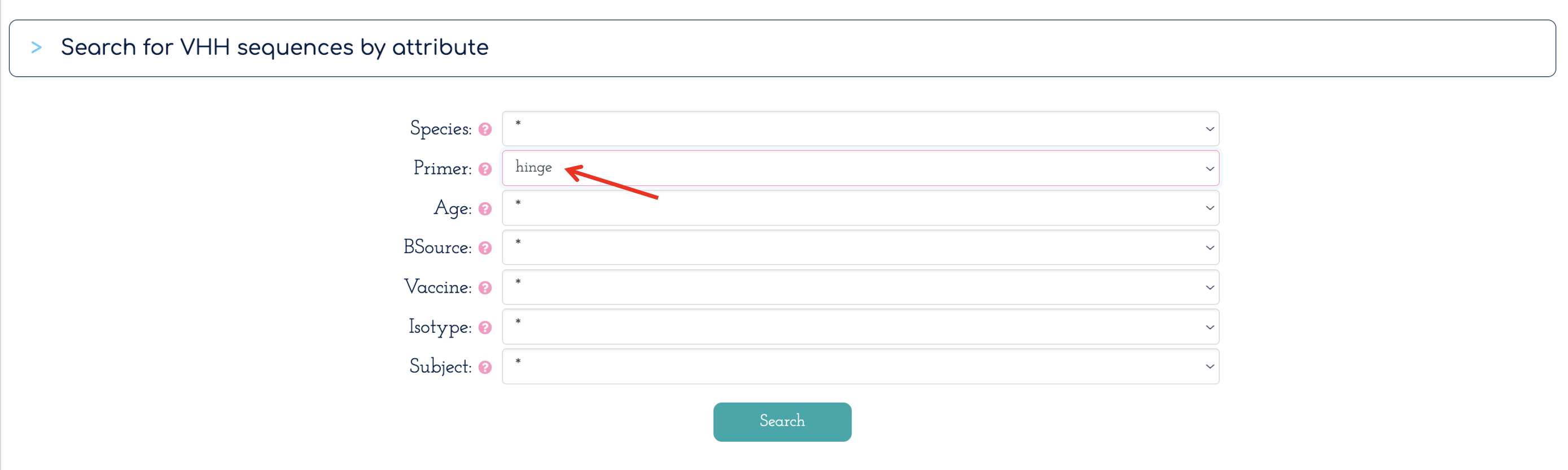
OAS-nano can be filtered according to attributes such as species, isotype, primer type, and deposition date. The fields are non-exclusive, meaning that the user could choose a combination of fields that does not exist in our database (for instance searching for datasets with a defined subject but undefined age will return no results because no such datasets are present in OAS-nano.)
Data and Downloads
Data in the OAS-nano database is organized into studies that are in turn subdivided into data units. A single data unit is a set of sequences uniquely identified by its metadata. The available metadata parameters are:
- Author – First author and date of publication.
- Link – Link to the publication associated with the study.
- Run – Run ID from which the sequence is derived.
- Species – Organism of the B-cell donor.
- Primer – Indicates the type of PCR primer used in the sequencing pathway. For more information, see the note on primer types.
- Age – Information on the age of the B-cell donor.
- Subject – Indicates whether the B-cells can be traced back to a particular individual.
- Isotype – Identified isotype information.
- Disease – Indicates whether the donor was sick at the time of B-cell extraction.
- Vaccine – Indicates whether the B-cell donor was purposely immunized prior to B-cell extraction.
- B-cell subset – Indicates whether a particular B-cell subset was sorted for Ig-seq.
- B-cell source – Organ or tissue from which the B-cells were extracted.
- Longitudinal – For longitudinal studies, indicates the time point at which B-cells were collected.
- Total sequences – Number of redundant sequences in the data unit.
- Unique sequences – Number of non-redundant sequences in the data unit.
- Deposition date – Date on which the dataset was deposited in OAS-nano.
- Last updated – Date on which the dataset was last updated.
After searching, there is an option to download all data-units that match your criteria. This is in the form of a shell script containing consecutive wget commands. To download all the data you can run the following command:
chmod u+rx bulk_download.sh
./bulk_download.sh
A series of .csv.gz files will then be downloaded to your current directory. Each .csv.gz file contains as the first line the metadata for the data-unit and the following lines each sequence and its annotations.
The contents of each data-unit file can look as below:
| sequence_id | sequence | sequence_aa | locus | stop_codon | vj_in_frame | v_frameshift | productive | rev_comp | complete_vdj | d_frame | v_call | v_call_species | d_call | d_call_species | j_call | j_call_species | sequence_alignment | germline_alignment | sequence_alignment_aa | germline_alignment_aa | v_alignment_start | v_alignment_end | d_alignment_start | d_alignment_end | j_alignment_start | j_alignment_end | v_sequence_alignment | v_sequence_alignment_aa | v_germline_alignment | v_germline_alignment_aa | d_sequence_alignment | d_sequence_alignment_aa | d_germline_alignment | d_germline_alignment_aa | j_sequence_alignment | j_sequence_alignment_aa | j_germline_alignment | j_germline_alignment_aa | fwr1 | fwr1_aa | cdr1 | cdr1_aa | fwr2 | fwr2_aa | cdr2 | cdr2_aa | fwr3 | fwr3_aa | fwr4 | fwr4_aa | cdr3 | cdr3_aa | junction | junction_length | junction_aa | junction_aa_length | v_score | d_score | j_score | v_cigar | d_cigar | j_cigar | v_support | d_support | j_support | v_identity | d_identity | j_identity | v_sequence_start | v_sequence_end | v_germline_start | v_germline_end | d_sequence_start | d_sequence_end | d_germline_start | d_germline_end | j_sequence_start | j_sequence_end | j_germline_start | j_germline_end | fwr1_start | fwr1_end | cdr1_start | cdr1_end | fwr2_start | fwr2_end | cdr2_start | cdr2_end | fwr3_start | fwr3_end | fwr4_start | fwr4_end | cdr3_start | cdr3_end | np1 | np1_length | np2 | np2_length | v_call_2 | v_call_3 | v_support_secondary | v_support_2 | v_support_3 | v_score_secondary | v_score_2 | v_score_3 | c_region | _species_rank | Redundancy | ANARCII_numbering | tetrad_residues | v_call_species_matches_organism | d_call_species_matches_organism | j_call_species_matches_organism | ANARCII_status |
|---|---|---|---|---|---|---|---|---|---|---|---|---|---|---|---|---|---|---|---|---|---|---|---|---|---|---|---|---|---|---|---|---|---|---|---|---|---|---|---|---|---|---|---|---|---|---|---|---|---|---|---|---|---|---|---|---|---|---|---|---|---|---|---|---|---|---|---|---|---|---|---|---|---|---|---|---|---|---|---|---|---|---|---|---|---|---|---|---|---|---|---|---|---|---|---|---|---|---|---|---|---|---|---|---|---|---|---|---|---|---|---|---|---|---|---|
| DRR378864.223278 | CAGGTGCAGCTC... | QVQLVESGGGLV... | H | F | T | F | T | T | T | 0 | IGHV3S1*01 | alpaca | IGHD4*01 | alpaca | IGHJ6*01 | alpaca | CAGGTGCAGCTC... | CAGGTGCAGCTG... | QVQLVESGGGLV... | QVQLVESGGGLV... | 1 | 295 | 306 | 315 | 324 | 370 | CAGGTGCAGCTC... | QVQLVESGGGLV... | CAGGTGCAGCTG... | QVQLVESGGGLV... | CTATAGGGAC | YRD | CTATAGCGAC | YSD | TGACTTTGCGTC... | DFASRGQGTRVT... | TGACTTTGGTTC... | DFGSWGQGTQVT... | CAGGTGCAGCTC... | QVQLVESGGGLV... | GGATTCTCCTTC... | GFSFRSFW | ATGTATTGGGCC... | MYWARQAPGKGL... | ATTAATATTAAT... | ININGGLT | CTCTATTCGGAC... | LYSDSVKGRFTI... | AGGGGCCAGGGG... | RGQGTRVTVSS... | GCAAAAGGAAAG... | AKGKDAYRDSRG... | TGTGCAAAAGGA... | 54 | CAKGKDAYRDSR... | 18 | 380.457 | 14.146 | 56.445 | 295M87S1N | 305S3N10M67S6N | 323S1N47M12S | 2.710000e-108 | 2.331 | 1.590000e-12 | 91.186 | 90 | 87.234 | 1 | 295 | 1 | 295 | 306 | 315 | 4 | 13 | 324 | 370 | 2 | 48 | 1 | 75 | 76 | 99 | 100 | 150 | 151 | 174 | 175 | 288 | 337 | 369 | 289 | 336 | GAAAGGACGC | 10 | AGTCGAGG | 8 | IGHV3S25*01 | IGHV3S6*01 | 2.710000e-108 | 3.390000e-102 | 2.210000e-99 | 380 | 360 | 350 | AACCCAAGACAC... | 0 | 1 | {'fwh1': {'1 ': 'Q', '2 ': 'V', '3 ': 'Q... | 42: A, 49: G, 50: L, 52: W | True | True | True | |Deletions: 10, 73|||| |
| DRR378864.233899 | CAGGTGCAGCTC... | QVQLVESGGGLG... | H | F | T | F | T | T | T | 0 | IGHV3S53*01 | alpaca | IGHD5*01 | alpaca | IGHJ4*01 | alpaca | CAGGTGCAGCTC... | CAGGTGCAGCTG... | QVQLVESGGGLG... | QVQLVESGGGLV... | 1 | 291 | 296 | 302 | 305 | 346 | CAGGTGCAGCTC... | QVQLVESGGGLG... | CAGGTGCAGCTG... | QVQLVESGGGLV... | GTTGGGG | WG | GTTGGGG | WG | ATGCCTCCTGGG... | ASWGHGPRVTLA... | ATGACTACTGGG... | DYWGQGTQVTVS... | CAGGTGCAGCTC... | QVQLVESGGGLG... | GGGACCAGCTTC... | GTSFTPES | ATGGGCTGGGAC... | MGWDRQVPGKER... | ATCACTACTCAT... | ITTHGST | AATTATGCAGAC... | NYADSVKDRFTI... | TGGGGCCACGGG... | WGHGPRVTLAS... | AATGCAAAGTGT... | NAKCWGNAS... | TGTAATGCAAAG... | 33 | CNAKCWGNASW... | 11 | 336.830 | 14.146 | 41.064 | 291M78S2N | 295S9N7M67S3N | 304S6N42M23S | 3.540000e-95 | 2.250 | 6.540000e-08 | 86.942 | 100 | 83.333 | 1 | 291 | 1 | 291 | 296 | 302 | 10 | 16 | 305 | 346 | 7 | 48 | 1 | 75 | 76 | 99 | 100 | 150 | 151 | 171 | 172 | 285 | 313 | 345 | 286 | 312 | AAGT | 4 | CA | 2 | IGHV3S55*01 | IGHV3S57*01 | 3.540000e-95 | 7.380000e-85 | 7.380000e-85 | 336 | 302 | 302 | AACCCCCTCCAC... | 0 | 1 | {'fwh1': {'1 ': 'Q', '2 ': 'V', '3 ': 'Q... | 42: D, 49: E, 50: R, 52: V | True | True | True | |Deletions: 10, 73|||| |
For information on sequence notation, please refer to: Nucleic acid notation
A convenient way to parse the csv.gz files, is to use the following code to extract the metadata as a json object and the sequences as a pandas object.
Downloading using Safari: In some cases Safari automatically unzips the .csv.gz files when downloading. This automatic unzipping can cause problems with the downloaded file and it is therefore recommended to either turn off automatic unzipping or use a different browser (e.g. Firefox or Chrome).
Primer types
Before sequencing, VHH sequences are first amplified using PCR. This process uses primers that bind to specific regions of the target sequence. In VHH sequencing, two main primer strategies are commonly used:
- Nested primers anneal to the IGHV3-specific leader sequence present in both VH and VHH sequences. VH and VHH products are subsequently separated by mass before the VHH fraction is re-amplified. Because this separation is imperfect, nested-primer datasets may contain some VH contamination. Furthermore, only IGHV3-derived sequences are recovered.
- Hinge primers anneal to the long- or short-hinge regions unique to VHHs. They are paired with either leader primers targeting the IGHV1, IGHV3, and IGHV4 V-gene families or a general framework region 1 (FWR1) primer. Because amplification is specific to the VHH hinge region, hinge-primer datasets largely avoid VH contamination and recover a broader range of V-gene families than nested-primer datasets.
Although some studies use a FWR1 primer rather than family-specific leader primers, no sequences from V-gene families outside IGHV1, IGHV3, and IGHV4 are currently represented in OAS-nano because suitable camelid IMGT reference genes are unavailable for their identification.
Additional primer type:
- Nested hinge primers combine the nested and hinge primer approaches by performing successive rounds of amplification with general VH/VHH and hinge-specific primers. The amplified VH and VHH products are then separated by mass which is an imperfect process and may result in VH contamination. As with nested primers, this method amplifies only IGHV3-derived sequences.
Primer diagrams
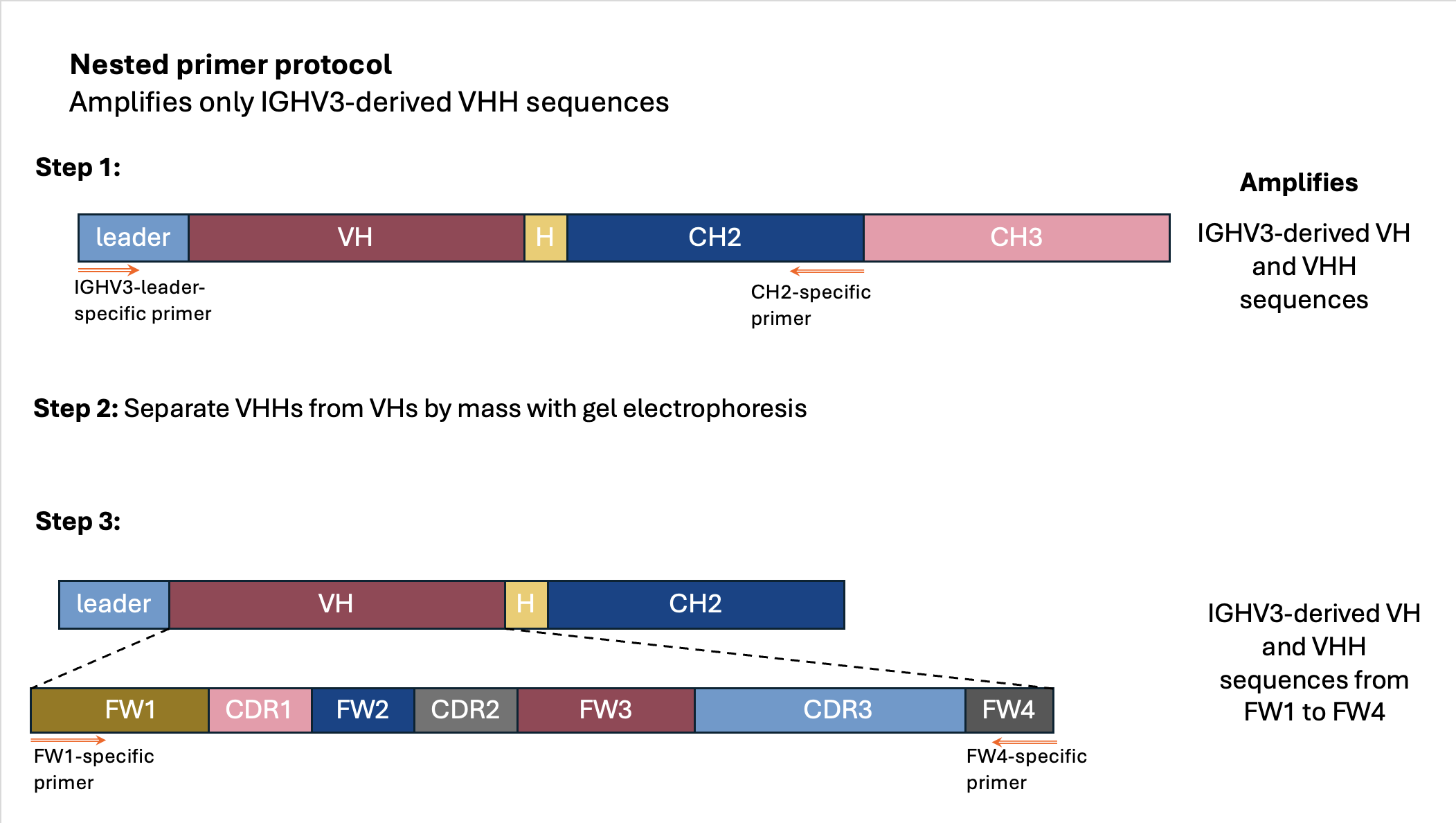
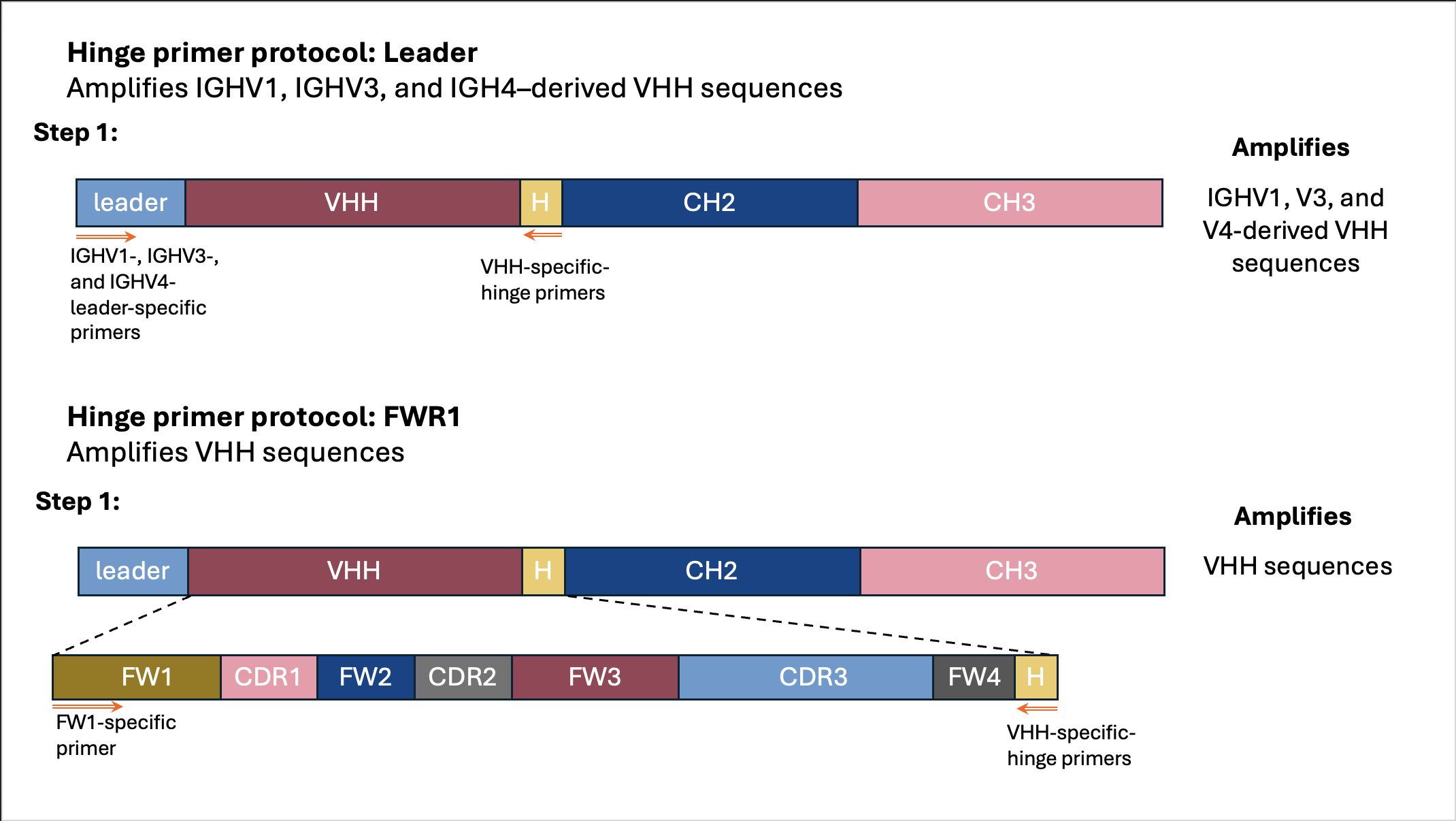
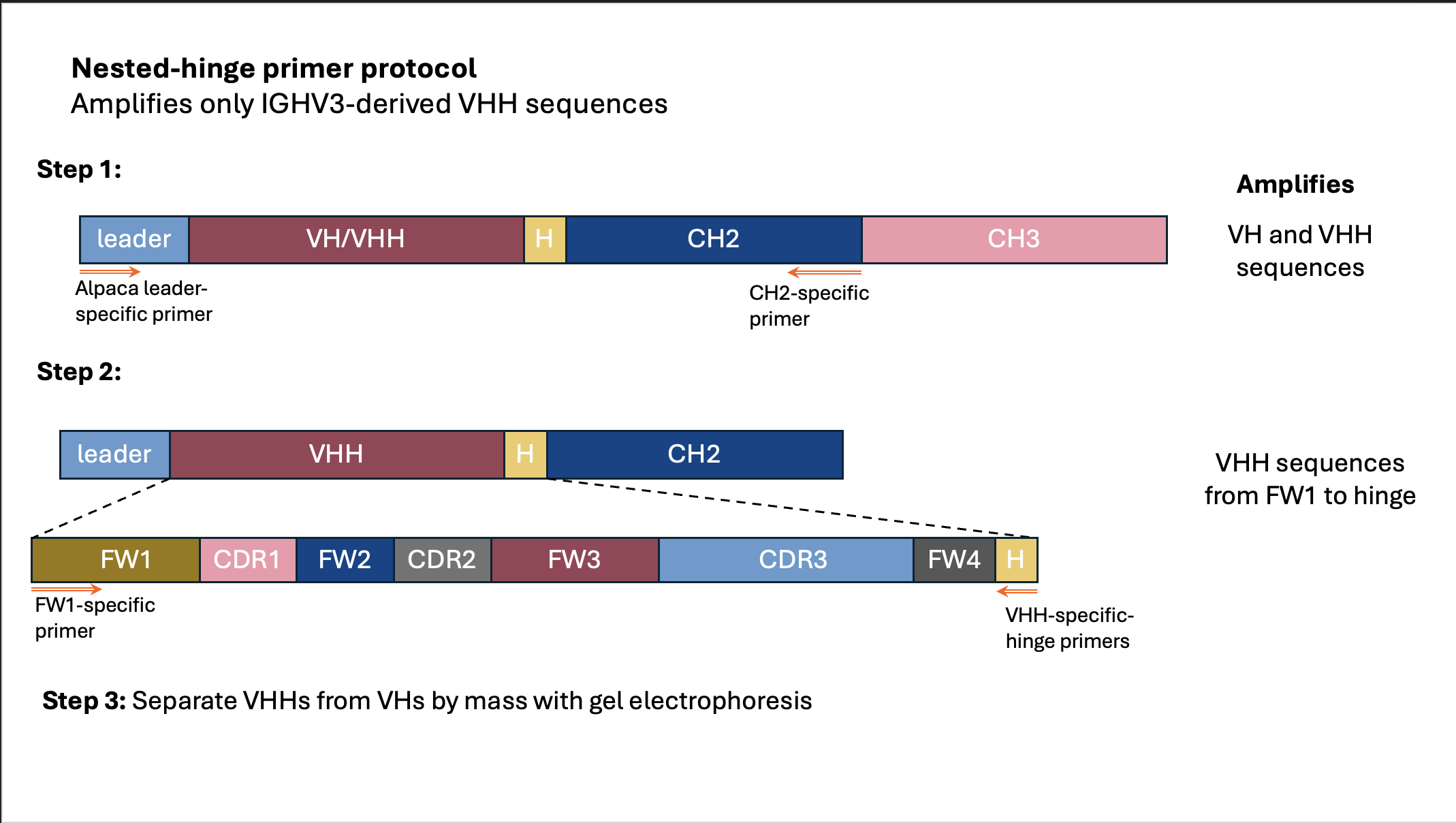
Notes
Germline gene assignment
The V, D, and J genes predicted for each sequence are assigned using IgBLAST with camelid reference gene sets from IMGT. However, the IMGT reference gene sets are incomplete. Only alpaca reference sets are available for D and J genes, while V-gene assignment relies on incomplete reference sets from both alpaca and dromedary camel.
For germline-dependent analyses, such as analysis of
somatic hypermutation, ensure that
<gene>_call_species_matches_organism is
TRUE.
FAQ
How do I bulk-download sequences from OAS-nano?
After filtering OAS-nano using your desired search criteria, you will be taken to a results page. At the top of this page, you'll find a link to a shell script that downloads all matching datasets.
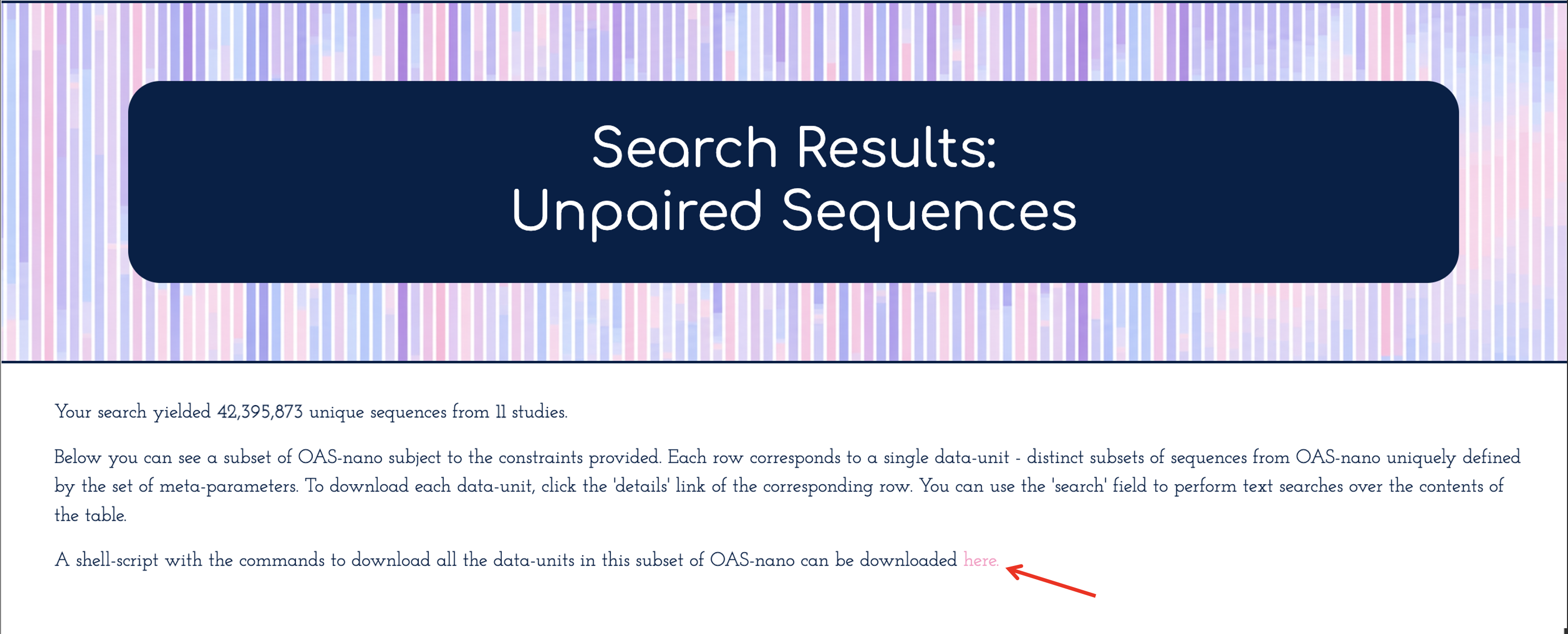
Download the script, then run:
chmod +x bulk_download.sh
./bulk_download.sh
This will download every dataset returned by your search.
I'm creating a pretraining dataset for a machine learning model and want to collect as many VHH sequences as possible. How should I search?
To retrieve all datasets in OAS-nano, set every search field to
*. This returns the complete database, allowing you to build a
comprehensive pretraining dataset.
I want to investigate the diversity of natural camelid VHH repertoires. How should I search to maximize natural diversity?
To maximize sequence diversity, set Primer to hinge. Hinge primers amplify VHH sequences using the VHH-specific short and long hinge regions and are paired either with leader sequence primers that amplify the IGHV1, IGHV3, and IGHV4 V-gene families or with a general framework region 1 primer.
In contrast, the nested primer strategy uses a primer that binds only to the IGHV3 leader sequence, restricting amplification to IGHV3-derived sequences. No datasets in OAS-nano currently contain sequences from V-gene families outside IGHV1, IGHV3, and IGHV4, despite evidence for the existence of additional families such as IGHV5 and IGHV7, because no IMGT reference sequences are available for these families. Consequently, hinge-primer datasets provide the broadest representation of V-gene family diversity currently available in OAS-nano.
For more information, see the Primer types section.
I'm studying V-gene usage in camelids. How can I obtain the most reliable V-gene assignments?
After selecting your datasets, first filter for species-matched V-gene assignments
by retaining only sequences where
v_call_species_matches_organism = TRUE. V-gene assignments from other
species are not appropriate for analyses of species-specific V-gene usage.
Currently, only alpaca sequences in OAS-nano can have species-matched V-gene
assignments.
You can further increase confidence by filtering on the
v_support column.
To assess confidence at the V-gene family level, examine
v_call_2 and v_call_3, which contain the second- and
third-ranked V-gene assignments. If these belong to the same V-gene family as the
top hit, you can be more confident in the assigned V-gene family.
If v_call_2 and v_call_3 are empty, only a single
germline V-gene could be assigned with sufficient confidence. In these cases, the
v_call assignment is unambiguous and is particularly well suited for
analyses of germline V-gene usage.
Contact
If you would like to contact us about anything related to OAS-nano, please drop an email to opig@stats.ox.ac.uk.